What digital marketing is
Digital marketing means promoting a business, product or idea through online channels and digital devices. Those channels include search engines, social media, email, websites, video, messaging apps and online ads. The goal is to reach the right people, earn their trust, and turn them into customers who stay.
Traditional marketing uses billboards, print, TV and radio. Digital marketing differs in three ways:
- Targeting: you can reach specific audiences instead of everyone.
- Measurement: you can see clicks, sign-ups and sales instead of guessing.
- Speed and cost: you can start with a small budget, test quickly and adjust the same day.
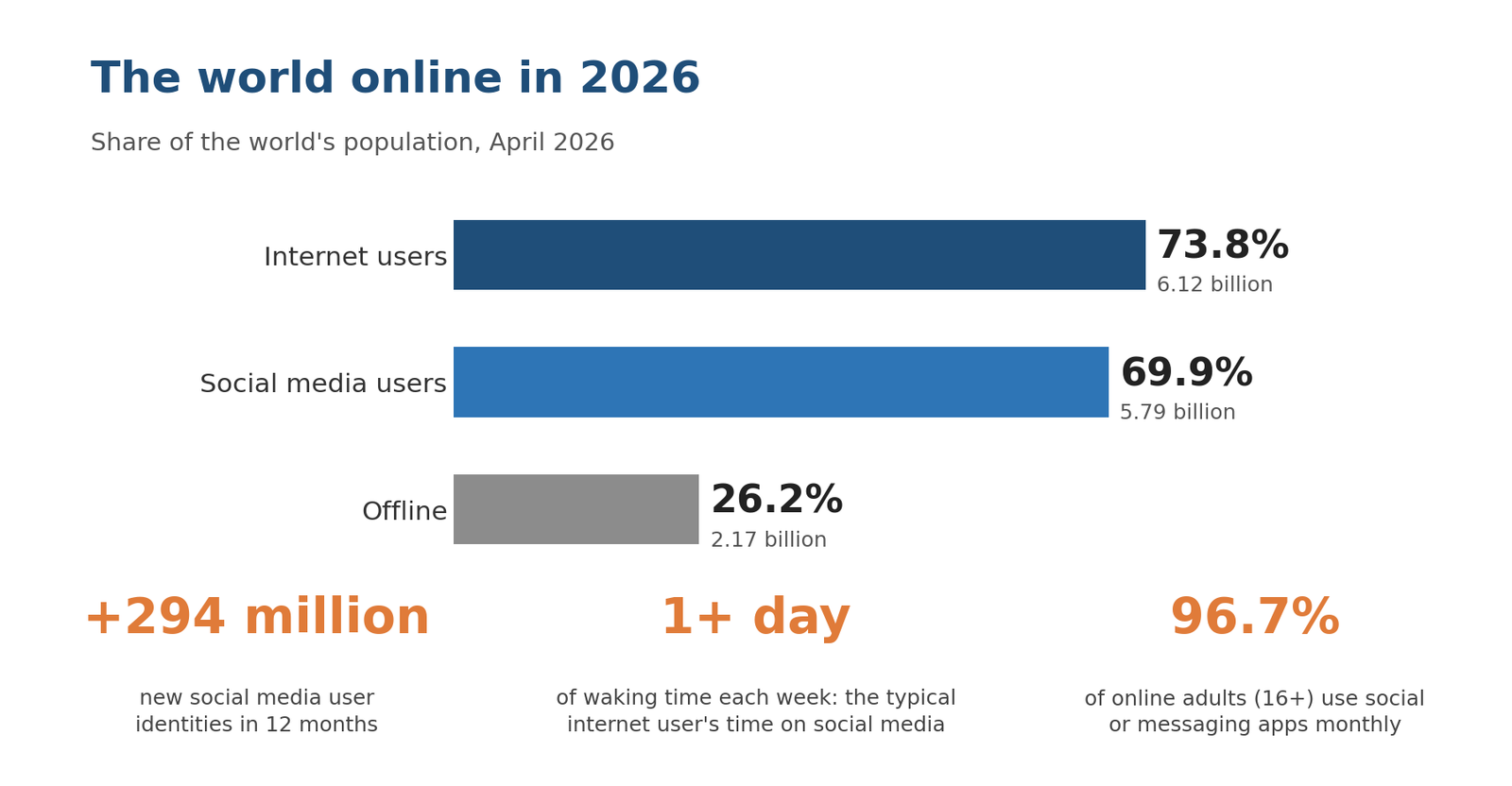
The audience is enormous. The number of people using the internet reached 6.12 billion at the start of April 2026, or 73.8% of the world’s population, and social media user identities reached 5.79 billion. The typical internet user spends more than one full waking day each week on social media. Customers are online, and so are your competitors.
The money follows the audience. Dentsu forecasts global advertising spend at about $1.06 trillion (about ₹102 trillion) in 2026, with roughly 69% of it going to digital channels.
How it works: the customer journey
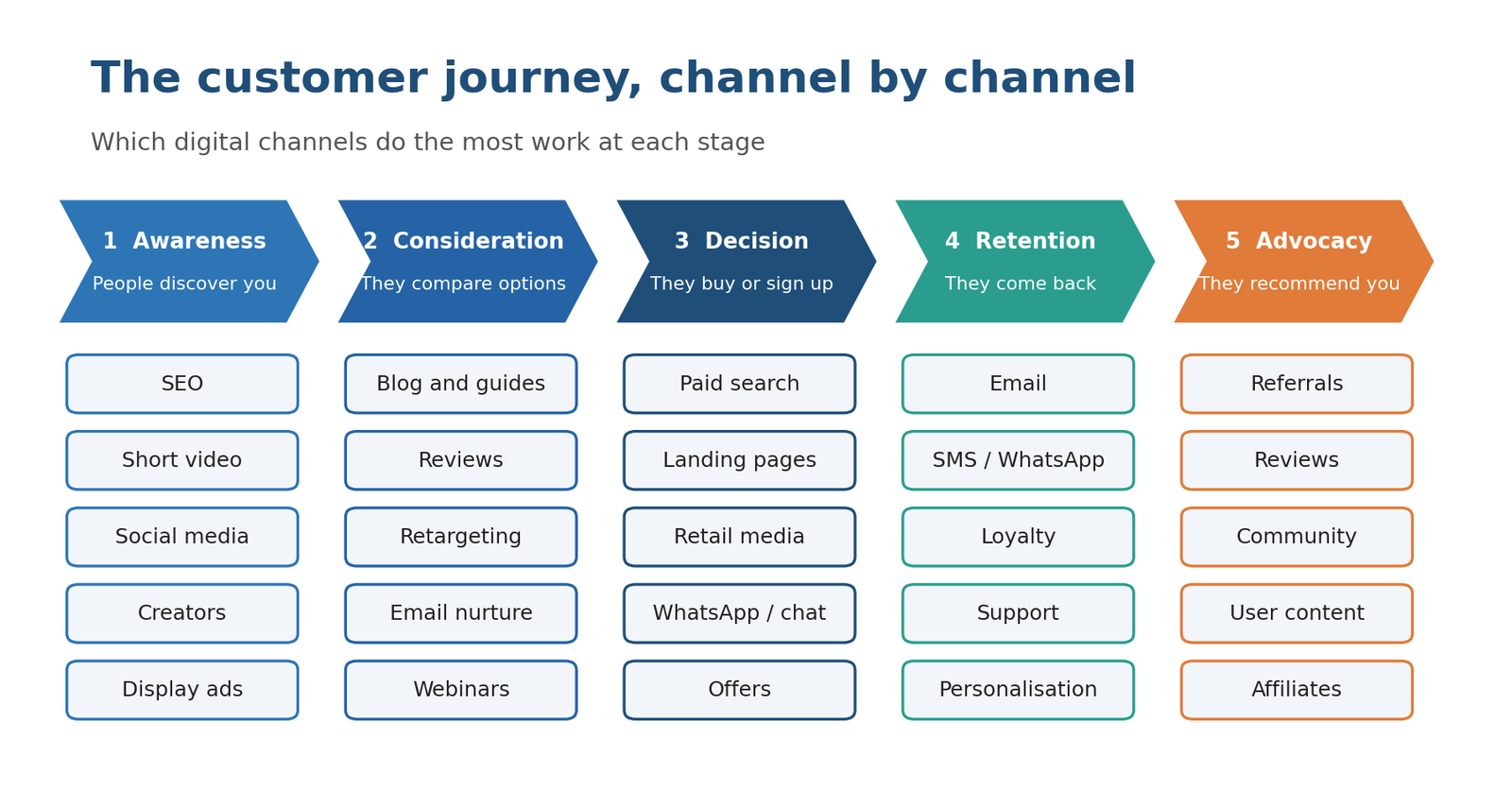
Almost every purchase follows these stages:
- Awareness: a person discovers you, through a search, a video, a post or a friend.
- Consideration: they compare options, read reviews and visit your site.
- Decision: they buy, book or sign up.
- Retention: they get good service and a reason to come back.
- Advocacy: they recommend you to others.
Each digital channel does a different job in this journey. In practice, people do not move in a straight line. They go back and forth between researching and comparing, and often decide inside a search result, a short video or an AI chat answer. Think of marketing as a loop: attract people, earn their trust, convert them, then use their data and referrals to attract more.
The core channels
|
Channel
|
What it does
|
Main metrics
|
|---|---|---|
SEO. You help search engines understand your pages and trust your site, through useful content, a fast mobile-friendly website, clear structure and credible links. It takes months, but traffic keeps coming without paying per click.
Paid search. Ads appear when someone searches a phrase such as “best running shoes”. You pay when they click. It captures people who already want something, so it often converts well.
Social media. Each platform has a role. Instagram and YouTube suit visual and video storytelling, LinkedIn suits B2B, Facebook suits communities and local reach, and X suits news and conversation. Choose the two or three where your customers actually spend time.
Content marketing. Blog posts, videos, newsletters, case studies and tools that answer your customers’ questions. Good content powers every other channel.
Email marketing. You own your list, unlike followers on a platform. The most-quoted benchmark is $36 back for every $1 spent, a figure Litmus published without a survey year, though dated evidence puts most programs between 10:1 and 50:1. In rupee terms, that means about $36 (about ₹3,470) back for every $1 (about ₹96) spent. The ratio holds in any currency: spend ₹1,000 (about $10.40) and the benchmark suggests roughly ₹36,000 (about $374) in return. Treat it as a rough guide, not a promise.
Influencers and creators. People trust people more than logos. Small creators with loyal niche audiences often outperform big names for the cost. Meta puts creator-economy ad spend at about $37 billion (about ₹3.6 trillion).
Analytics and CRO. Tools like Google Analytics 4 show where visitors come from and where they drop off. Small fixes such as clearer headlines, shorter forms and faster pages can raise sales without more traffic.
The essentials every marketer needs
1. Clear goals. Choose goals tied to the business, such as leads, sales or sign-ups, not just likes. Use targets with numbers and dates.
2. A defined audience. Know who you serve, their problems, where they search and what makes them trust you.
3. Positioning. Be clear about why someone should choose you over alternatives.
4. A website that converts. It should be fast, mobile-first, secure, easy to navigate and built around one clear action per page.
5. Content and a calendar. Plan topics around customer questions at each stage of the journey, and publish consistently.
6. Tracking. Install analytics, set up conversion tracking and use UTM links so you know what works.
7. Budget and testing. Start small, test one change at a time and shift money toward what performs.
Key metrics to know:
- CTR (click-through rate): clicks divided by views.
- Conversion rate: the share of visitors who take your desired action.
- CPA / CAC: cost to acquire a customer.
- ROAS: revenue earned per unit of ad spend.
- LTV: how much a customer is worth over time.
- Churn / retention: how many customers leave or stay.
What changed in 2026
Search was rewritten
Google now shows AI-written summaries (AI Overviews) and an AI Mode for conversational searches. Many answers appear without a click to any website. A randomized field experiment found AI Overviews cut organic clicks by 38% on the queries where they appeared. On the other hand, brands cited inside those summaries earned more clicks than uncited ones. Visibility now means being the source the answer is built from, not just ranking in the list.
Google’s quality updates were frequent
Google ran several confirmed updates this year:
- A Discover update from February 5 to 26, a spam update on March 24 and 25, and a core update from May 21 to June 2. A broad core update also ran from late March into early April.
- A second spam update followed in June, and another spam update arrived in August.
Spam updates target scaled content abuse, meaning mass-produced low-value pages, while useful and accurate AI-assisted content can still rank. The lesson is that volume doesn’t help. First-hand experience, original information and trust do.
Ad platforms automated more
Google’s AI Max, Performance Max and Meta’s Advantage+ now handle much of the targeting, bidding and creative testing. Marketers have less control over settings and more responsibility for creative, product data and conversion tracking. OpenAI also began testing ads inside ChatGPT in February 2026, a new place to reach people while they research.
Retail media, which means ads on marketplaces and retailer sites, is growing fast. WARC expects it to reach about $200.4 billion (about ₹19.3 trillion) in 2026.
Privacy and data rules tightened
Google kept third-party cookies in Chrome and retired its Privacy Sandbox project in October 2025, but privacy laws keep growing. India’s DPDP Rules, notified in November 2025, require full compliance by May 2027, with penalties of up to ₹250 crore (about $26 million). Collect data with clear consent and build on first-party data such as email lists and customer records.
Measurement matured
Marketers increasingly mix three methods: attribution for daily optimization, incrementality tests to prove what actually caused sales, and marketing mix modeling for budget decisions. Asking customers “how did you hear about us?” is a simple, free way to fill gaps.
The biggest trends in 2026
- Zero-click and AI-answer visibility. Optimize to be cited, not just clicked. This is sometimes called GEO or AEO.
- Short-form video everywhere. Reels, Shorts and TikTok dominate discovery, and social platforms are used as search engines.
- Creator-led marketing. Brands are shifting budget to micro-creators and turning creator posts into ads.
- First-party data and owned channels. Email lists, communities and loyalty programs are safer and more valuable than rented audiences.
- Retail media. Ads inside marketplaces and retailer sites are one of the fastest-growing ad categories.
- Conversational and messaging marketing. WhatsApp, chat and voice make it normal to talk with customers one-to-one.
- Personalization at scale. Messages, offers and pages tailored to behavior, as long as data use is transparent.
- Authenticity and trust. Audiences notice low-effort, mass-produced content. Real people, real results and honest disclosure stand out.
- Smarter measurement. Proving what actually works matters more than reporting clicks.
- Automation with human oversight. Tools handle repetitive work, and people supply strategy, creativity and judgment.
Where AI fits in digital marketing
AI is now part of nearly every channel. It speeds up the work but does not replace strategy. Common uses:
|
Area
|
How AI helps
|
Example tools
|
|---|---|---|
Use AI as an assistant. Review facts, add original insight and keep your brand voice. Unedited, mass-produced AI content is exactly what Google’s spam updates target.
Examples that show it working
- Small local business: a bakery sets up a Google Business Profile, posts short videos of its baking, collects reviews and builds an email list with a discount offer. Search brings in nearby customers, video builds familiarity, and email brings people back.
- Online store: a skincare brand runs product-feed ads, works with micro-creators, and sends post-purchase emails with how-to guidance. Each channel handles a different stage of the journey.
- Campaign creativity at Cannes Lions 2026: The Ordinary’s “The Periodic Fable” challenged vague beauty claims with transparency. Mercado Livre’s “Field Barcode” put scannable patterns on football pitches that turned broadcasts into discounts. Clash Royale’s “Copycats Welcome” embraced copycat games rather than fighting them. All three show that ideas that invite participation or build trust still win.
Common mistakes to avoid
- Being on every platform instead of doing two or three well.
- Chasing followers instead of leads and sales.
- Publishing content without a goal, audience or tracking.
- Ignoring mobile speed and page experience.
- Buying lists or collecting data without consent.
- Letting automated ad systems run without good creative or clean conversion data.
- Judging results after a week instead of testing properly.
A simple roadmap to start
Month 1: Foundation. Define your goal and audience, set up your website, analytics and Google Business Profile, and pick two channels.
Month 2: Create and launch. Publish helpful content, start an email list, run a small ad test and post consistently.
Month 3: Measure and improve. Review what drove leads or sales, double down on winners, cut the rest and test one new idea.
Conclusion
Digital marketing in 2026 is the same discipline it has always been: understand people, solve their problems, and earn their trust where they spend time. What has changed is the speed and the interface. Search gives answers directly, ads run on automation, privacy rules protect users, and measurement demands proof. If you master the fundamentals (audience, content, channels, data and measurement) and use new tools wisely, you can compete at any budget.